
Warehouse Roofing

Scroll
Warehouse Roofing

Property Type for Columbus commercial properties

Warehouse Roofing

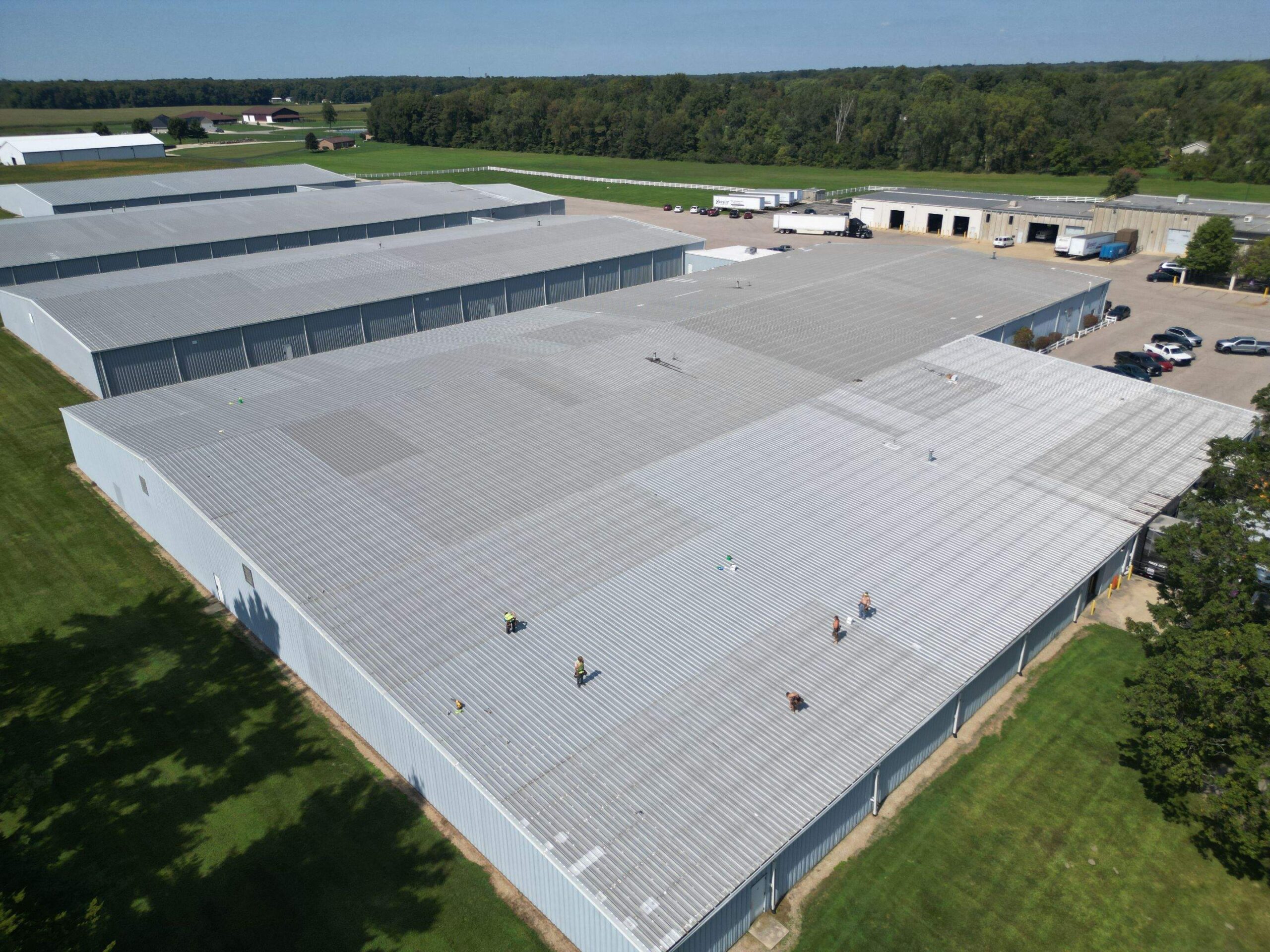
Warehouse roofs are defined by scale and exposure. A single low-slope field can stretch across multiple acres of uninterrupted membrane, and that vast, flat expanse is the most economically significant — and most vulnerable — surface on the building. Get the system, the slope, and the wind specification right and a warehouse roof protects millions of dollars of stored goods, racking, and equipment for decades with minimal fuss. Get them wrong and you have ponding, blow-offs, and leaks over inventory that can't easily be moved. Central Ohio has become one of the country's busiest logistics and storage markets, defined by the Rickenbacker cargo corridor, the I-70 and I-71 industrial belt, and the explosive Licking County growth zone near the new Intel and Amazon developments — and every one of those buildings rides on a big, low-slope roof.

The climate makes the engineering matter. Columbus sits in ASHRAE/IECC climate zone 5A — cold and humid — with roughly 65 to 70 freeze-thaw cycles a year, real snow and ice loads in winter, and humid summers that make reflective membranes a genuine energy play across acres of roof. The region also sits on the eastern edge of the Midwest hail belt, with spring and summer storms that bring high wind and occasional 1-inch-plus hail. On a tall warehouse out in the open along an interstate corridor, wind-uplift is often the governing design factor, which is why FM and UL ratings sit at the center of how these roofs get specified. This page focuses on storage, 3PL, and manufacturing-adjacent warehousing — buildings where the structure and the wind engineering, more than freight-dock sortation, drive the roofing decisions.

Warehouse Roofing decision points

Warehouse roofs are defined by scale and exposure. A single low-slope field can stretch across multiple acres of uninterrupted membrane, and that vast, flat expanse is the most economically significant — and most vulnerable — surface on the building. Get the system, the slope, and the wind specification right and a warehouse roof protects millions of dollars of stored goods, racking, and equipment for decades with minimal fuss. Get them wrong and you have ponding, blow-offs, and leaks over inventory that can't easily be moved. Central Ohio has become one of the country's busiest logistics and storage markets, defined by the Rickenbacker cargo corridor, the I-70 and I-71 industrial belt, and the explosive Licking County growth zone near the new Intel and Amazon developments — and every one of those buildings rides on a big, low-slope roof.

What gets verified on the roof

The climate makes the engineering matter. Columbus sits in ASHRAE/IECC climate zone 5A — cold and humid — with roughly 65 to 70 freeze-thaw cycles a year, real snow and ice loads in winter, and humid summers that make reflective membranes a genuine energy play across acres of roof. The region also sits on the eastern edge of the Midwest hail belt, with spring and summer storms that bring high wind and occasional 1-inch-plus hail. On a tall warehouse out in the open along an interstate corridor, wind-uplift is often the governing design factor, which is why FM and UL ratings sit at the center of how these roofs get specified. This page focuses on storage, 3PL, and manufacturing-adjacent warehousing — buildings where the structure and the wind engineering, more than freight-dock sortation, drive the roofing decisions.

How the Columbus property context affects the scope

The building type affects staging, work hours, tenant protection, rooftop equipment coordination, drainage review, access routes, and closeout documentation.

What ownership receives

The result is a property-specific roof plan that protects the building use while giving ownership a clear scope, schedule, access plan, and budget path.

Questions

Warehouse Roofing questions

Why is wind-uplift the biggest concern on a Columbus warehouse roof?

Because warehouses are tall and exposed — often out along the I-70/I-71 belt or near Rickenbacker with little to break the wind — and a perimeter or corner failure on a multi-acre roof can progress into a catastrophic blow-off in one storm. We design to FM/UL wind ratings matched to the building's height and exposure, increase fastening in the perimeter and corner zones, and detail edge metal to ANSI/SPRI ES-1 so wind can't get a grip on the membrane.

Why is mechanically-attached TPO so common on these buildings?

Economics and performance at scale. Over acres of open low-slope field, a mechanically-attached, reflective, weldable single-ply like TPO installs efficiently and costs less than a fully-adhered system, while the white surface cuts summer cooling load. The fastening pattern is engineered to the wind spec, so the savings don't come at the expense of uplift resistance. Fully-adhered systems are still used where exposure or performance needs justify them.

Can you re-roof our warehouse while we keep operating 24/7?

Yes. We phase the work across the large field, protect the racking and inventory under each active zone, coordinate tear-off around areas that can be cleared or covered, and keep every section weather-tight at the end of the shift. Material and crane staging is planned so it never blocks dock and truck movement, so day-to-day throughput keeps running.

Talk through warehouse roofing.

Share the building address, roof history, current concern, timing, and access constraints. We will give you a practical next step for inspection, repair, maintenance, coating, or replacement planning.

Contact Commercial Roofers of Columbus